Poor Teachers

Teaching has always been one of those professions which is driven by passion or idealism — the desire to teach the young about a subject the teacher thinks is worthwhile for them to know — and as with all professions that can call on people with such idealism, the pay sucks. It’s just as true for professions like acting, advertising, music and the like: you’ve got a market which just begs to exploit its workers, hence the appearance of institutions like the Screen Actors Guild and teachers’ unions which negotiate things like pay scales and working hours.

The people who sit at the bottom end of the totem pole are the part-timers: the people who don’t work enough to qualify for industry benefits, or who are kept outside the part of the hierarchy which does. Part-time creative types (as explored here) employed by ad agencies are little more than hired guns, used for a particular project and then fired when the thing ends.

What happened in tertiary education was that the academe created one way to protect its long-serving or more meritorious teachers: tenure, or the reward for a person who could continue to work at their subject (with research and/or teaching) with a certain degree of job security. It’s the dictionary definition of a guild, by the way.

I remember talking to several of my erstwhile professors when I was still a student and thinking about life after graduation, and while all of them encouraged me to go further with post-grad study (a couple still pester me to do so, incidentally), they were also all very circumspect in telling me that my job prospects would be good (because of my scholarship), but my actual employment was likely to be shaky. Even with a PhD., the best I could hope for was adjunct-professorship, which did not excite me for obvious reasons. (Then Life intervened and I had to quit any thoughts of doing that anyway.)

So this article (via Insty) evoked from me a wry smile, because it epitomizes for me not the plight of the adjunct professor who’s been forced to become a call-girl, but just emblematic of the teaching profession in general.

There is nothing she would rather do than teach. But after supplementing her career with tutoring and proofreading, the university lecturer decided to go to remarkable lengths to make her career financially viable.
She first opted for her side gig during a particularly rough patch, several years ago, when her course load was suddenly cut in half and her income plunged, putting her on the brink of eviction. “In my mind I was like, I’ve had one-night stands, how bad can it be?” she said. “And it wasn’t that bad.”

Sex work is one of the more unusual ways that adjuncts have avoided living in poverty, and perhaps even homelessness.

I used to know two women, one a schoolteacher, the other a theater actress, who had to resort to this activity because they just couldn’t make ends meet on their pittance of a salary. And I’ve talked before about how I feel about prostitution — or rather, the change in my attitude towards it over time. And ironically, female adjuncts have it easier because the prostitution market favors women over men. Men deliver pizzas, women sell their bodies.

Glenn thinks that this phenomenon means that the Ivy League should be abolished. I differ somewhat in that I fail to see why academics should be treated differently from any other profession — in other words, if adjunct professors as a group are being ill-treated by their employers, they should form a union just as movie actors did back in the 1930s. There’s nothing sacred about the academe, after all: it’s a profession like any other; and its purported lofty idealism doesn’t make it any more special — especially when the institution treats its lower-tier workers so badly that they have to fuck strangers for money just to make ends meet.

So they’ve started to talk about unionizing, with a predictable response from the academe, which has ironically proven itself to be little different from the Gilded Age robber barons they would normally excoriate. In other words, the education establishment is no different from any other commercial institution, which kind of undermines the whole “sacred mission of educating” nonsense they’ve been spouting for decades.

And if they’re going to behave like corporations, perhaps — no, not perhaps — we should start treating them like one. On current performance, therefore, their results are pathetic: high dropout rates, ill-educated graduates, no ROI on university degrees, over-reliance on government funding, overpaid senior executives and authoritarian management. And let’s not forget our original thesis: junior staff needing to resort to prostitution to supplement their inadequate wages.

John D. Rockefeller would have fired the lot, if they’d run one of his companies in this way.

Music, Lyrics and Wisdom

I can’t remember if I’ve written before about my fondness for the romantic comedy Music and Lyrics, starring Hugh Grant and Drew Barrymore, but I will now.

Grant of course plays his typical screen persona of the diffident, occasionally-clueless Brit twerp — it works for him, and clearly works for pretty much everyone, so why not? — this time, as a has-been 80’s pop star who can write a lovely pop tune, while Barrymore is a ditzy girl who just happens to have a soaring, but unrealized talent as a lyricist. The movie shows how they meet and fall in love, and that’s all we need to say about the romance. But that’s not what interests me about the story.

You see, the movie is filled with all sorts of insight into the creative process. Anyone who wants to make some kind of living at being “creative” should watch this movie a dozen times, because there is so much received wisdom in the script that it should be used as a college text. A sample  is when Barrymore professes to be unable to write a couple of lines because she’s “not feeling inspired”, and Grant excoriates that nonsense by shouting explosively:

“Inspiration is for amateurs!”

No truer words were ever spoken. If you earn a living at anything, Rule #1 is that you have to show up for work every day — and not just show up, but produce something. It’s as true of the creative process as it is for an assembly-line worker.

I’m often asked how I can write something new for this blog each day, and my answer is quite simple: I sit down at my computer, and don’t get up until I’ve written at least two or three posts. Not all of them will get published — I’m very harsh towards my own writing — but I do this every single day, circumstances permitting. Note I use the word “circumstances” and not “inspiration”, because if you are truly creative, as Grant reveals above, you don’t need inspiration to produce something.

When I’m writing a novel, by the way, I spend at least ten hours a day writing. It could be new content, it could be research, or it could be editing; all of that is part of the creation of the work, and all of that is productive.

I remember fondly that when Jack Kerouac revealed that he wrote On The Road in one, long continuous explosion of creation, Truman Capote aptly commented: “That’s not writing; that’s typing!” And he’s absolutely correct: On The Road is a long, muddled and ultimately incoherent tract, and if it can be used for any “teaching moment” it shouldn’t be for its brilliant writing, but as an object lesson in how not to write a novel. Kerouac wrote a lot of other novels, and most of them are better than On The Road because he actually worked at them, rather than relying on creativity (fueled, it should be said, by booze and amphetamines: not the best of influences).

I know, I know: writing a pop song is not the same as writing a novel; but the process is the same.

Incidentally, Music and Lyrics also features a couple of other star turns: Haley Bennett is quite astonishing as a pop diva, and Kristin Johnson equally so as Barrymore’s middle-aged groupie wannabe sister. Come to think of it, there are no bad performances in this movie — and how often do you get to say that?

Oh Hell

Ever since Part 1 of my Britishland sabbatical and my horror at seeing what looked like a heavily-pregnant old man shooting clays (pic below), I’ve become very conscious of what I eat [diet details redacted because nobody wants to read that shit*].

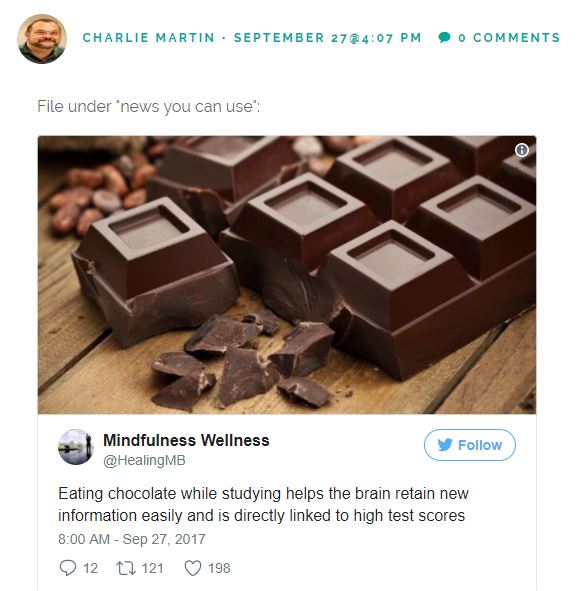
As a heretofore-lifelong chocolate eater, however, I can honestly say I hate Charlie Martin. Why?

Fortunately, I’m not studying, the only tests I face are of willpower when confronting my fourth or fifth pint of 6X, the only test I want to “pass” is a police blood-alcohol test, and I’ve had enough “new information” to last me several lifetimes, thank you. So I won’t be hitting the Aero or Milky Bars (my erstwhile choco-drugs of choice) anytime soon.

Unless, that is,  some scientist discovers that eating chocolate will make me irresistible to 55+ year-old women (and as we all know, another medical study will then “prove” that eating chocolate is linked to geriatric leprosy or something).


*Yes, I’m on a diet, for the first time in my life. No, I’m not going to talk about it because dieters are more boring than first-time mothers or even vegans. If it works, you’ll see pictorial proof at some point; if not, I’ll just go back to eating chocolate and drinking 6X to wash down my fish & chips / steak pies, and nobody will be any the wiser. And finally: all dietary advice in Comments which includes the words “paleo”, “crossfit” and other such foulness will be summarily stricken. In fact, don’t bother with any advice at all. You have been warned.

5 Worst Pieces Of Advice

Ranked in ascending order of awfulness:

  • Cops like it when you playfully wave a gun at them during a traffic stop
  • If you don’t like the Republican candidate, vote for the Democrat as a protest
  • The Second Amendment will protect you from arrest if you’re carrying a handgun in New Jersey
  • Not all women are like that
  • Swipe right — hey, you’re in Bangkok; what could possibly go wrong?

Your suggestions in Comments.

Neither Here Nor There

Okay, remember how some study or other said that 21 orgasms a month lowers prostate cancer rates? Surprise, surprise, nobody knows the truth:

According to a 2016 study in European Eurology, men who ejaculate more frequently are less likely to develop prostate cancer, compared to those who ejaculate less often.
The research from 2016 was a follow-up to a 2004 study, which came to a similar conclusion. Both studies found that the risk of prostate cancer may be reduced for men who ejaculate 21 times or more per month. This was compared with men who only ejaculated 4-7 times a month.
Other studies uncovered some conflicting evidence. Researchers disagree whether ejaculating more often makes men of all ages less likely to get prostate cancer.
A 2008 study found that frequent masturbation was only linked with a decreased risk of prostate cancer in men over 50. Researchers in this study found that men in their 20s and 30s who ejaculated more often were actually at an increased risk of prostate cancer.
In contrast, a 2003 study from Australia found that men who frequently ejaculated as young men had a reduced rate of prostate cancer.

In other words, nobody knows what the fuck [sic] is going on. So in the absence of any other alternatives:

Of course, if you can have 21 orgasms per month with a woman, then by all means go ahead, you lucky dog. Me, I’m going with the 2008 study because it gives me an excuse, so to speak.

And now, if you’ll excuse me…